
The AITECH Conference
The Maritime Standard AITech Conference 2026
24 November 2026 | Taj Exotica Resort, Dubai, UAE
Blog
October 2026
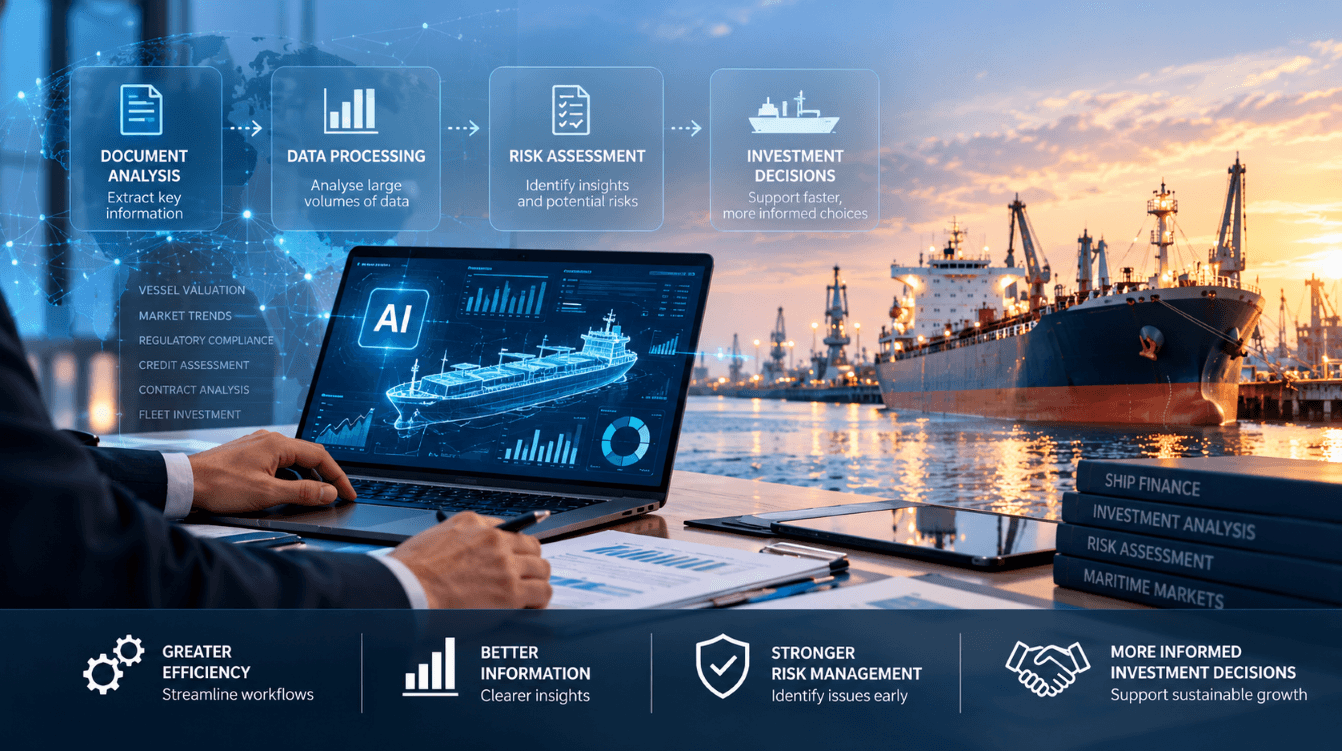
AI in Ship Finance: How Artificial Intelligence Is Changing Maritime Investment
AI in Ship Finance: How Artificial Intelligence Is Changing Maritime Investment
Shipping is a capital-intensive industry. Acquiring vessels, upgrading fleets, meeting regulatory requirements and investing in new technologies can require substantial long-term financing. For banks, leasing companies, shipowners and investors, evaluating these opportunities involves analysing complex financial, technical, contractual and regulatory information.
Artificial intelligence is beginning to offer new ways to manage this complexity. By helping financial institutions process documents, extract relevant information and analyse large volumes of data, AI can support parts of the ship financing process that have traditionally required extensive manual work.
A research paper published in May 2026 by Lasse Dierich and Orestis Schinas examines the application of AI to ship finance, including the use of large language models for document analysis, information extraction and workflow automation. The research highlights the potential for AI-assisted systems to support loan origination while recognising the challenges involved in deploying them reliably.
The significance extends beyond administrative efficiency. As shipping investment decisions become more complex, AI could help financial institutions assess information more systematically, identify issues requiring further investigation and improve the consistency of their analytical processes.
Why Ship Finance Is Suited to AI
Ship financing involves several interconnected areas of assessment. Lenders may need to examine a borrower's financial position, vessel specifications, valuation reports, employment arrangements, insurance documentation and contractual obligations.
These documents often come from different sources and may use different formats. Extracting the relevant information, checking consistency and preparing it for credit assessment can be resource intensive.
AI tools can assist by extracting information from documents, organising key data points and identifying missing or inconsistent details. Large language models can also help summarise lengthy documents, allowing finance professionals to locate relevant information more efficiently.
This does not mean that AI can replace financial analysis or legal review. Rather, it can help reduce repetitive processing and allow specialists to concentrate on questions that require judgement, experience and detailed investigation.
For lenders handling multiple financing applications, the potential value lies in making information easier to assess while maintaining appropriate review procedures.
Improving Loan Origination and Credit Assessment
Loan origination covers the processes involved in receiving, assessing and preparing a financing application. In ship finance, this can involve information from borrowers, brokers, technical advisers, valuation specialists and legal teams.
AI-assisted systems can help structure this information into a more consistent format. They may identify relevant clauses in financing agreements, extract figures from financial statements or flag missing documentation for review.
The resulting information can support the lender's existing credit assessment process. Analysts can use it to prepare initial reviews, compare relevant information and identify areas where additional evidence is needed.
However, extracting a figure from a document is not the same as verifying its accuracy. AI-generated summaries and extracted information must be checked against the original records, particularly when they influence credit decisions or contractual obligations.
The objective should be to make loan origination more efficient without weakening the standards applied to credit approval.
Assessing Vessel Value and Asset Risk
A vessel is often central to a ship financing arrangement, making its value and condition important considerations for lenders.
Assessing vessel value can involve factors such as vessel type, age, specifications, market conditions and the availability of comparable transactions. The relevance of each factor varies according to the asset and the purpose of the valuation.
AI can help organise market information, compare vessel characteristics and identify patterns across available datasets. These capabilities may support preliminary analysis and help analysts identify information requiring closer examination.
Nevertheless, valuation remains dependent on the quality of the underlying data and the assumptions used. Historical transactions may not reflect current market conditions, while differences between vessels can make direct comparisons misleading.
AI should therefore support qualified valuation professionals rather than be treated as an independent authority on asset value.
For lenders, the practical benefit is the possibility of combining faster information processing with established valuation methods and professional oversight.
Understanding Financial and Regulatory Exposure
Shipping finance increasingly requires lenders to consider more than a borrower's immediate financial position.
Vessel operations can be affected by changing market conditions, regulatory requirements, fuel choices, technology investments and the costs associated with maintaining or upgrading assets.
AI can help analysts organise information across these areas and identify questions that may require additional assessment. For example, a financing review might need to consider whether a proposed vessel upgrade is supported by credible technical information, whether projected costs are adequately documented, or whether assumptions about future operating conditions are reasonable.
In this context, AI is most useful as a tool for improving the completeness of an assessment. It cannot eliminate uncertainty or reliably predict every change in the market or regulatory environment.
Lenders still need to apply their own risk frameworks, examine assumptions and determine whether a proposed financing structure is appropriate.
Financing Maritime Technology Investments
AI also has a role to play in how shipping companies evaluate their own technology investments.
Shipowners face choices involving digital systems, automation, energy efficiency measures, equipment upgrades and other technologies. Each investment needs to be assessed against its expected costs, operational requirements and potential commercial benefits.
AI can help structure investment information, compare scenarios and test the sensitivity of financial projections to different assumptions. For example, an analyst could examine how a project's projected financial performance changes when installation costs, maintenance requirements or expected benefits vary.
Such analysis can make assumptions more visible and help decision-makers identify which factors have the greatest influence on an investment case.
However, the reliability of the results depends on the inputs. If projected savings or implementation costs are unrealistic, AI cannot make the resulting financial model reliable simply by processing the information more quickly.
Technology investment decisions still require credible evidence, realistic assumptions and a clear understanding of operational constraints.
The Role of Data in Maritime Investment
AI-assisted finance depends on the ability to access and interpret reliable information.
Shipping companies and financial institutions may hold relevant information across separate accounting systems, vessel records, contracts, technical reports and external databases. Differences in formats and data standards can complicate the process of bringing this information together.
The International Maritime Organization approved an overarching Strategy on Maritime Digitalization in March 2026. The strategy emphasises interoperability, standardisation, data sharing and effective data governance across maritime organisations and jurisdictions.
Although this strategy addresses maritime digitalisation more broadly, its underlying principles are relevant to AI-assisted finance. Financial analysis becomes more useful when the information supporting it can be accessed, understood and checked consistently.
For maritime businesses, improving data management can therefore support both operational digitalisation and financial decision-making.
Managing the Risks of AI in Finance
The use of AI in ship finance introduces its own risks.
AI systems can misinterpret documents, generate incorrect summaries or overlook important contractual details. Models may also produce inconsistent results when presented with information that differs from the data or situations for which they were designed.
These limitations matter in financing, where a seemingly minor error can affect a financial calculation, risk assessment or contractual interpretation.
Financial institutions should establish clear controls around data access, model testing, output verification and human approval. Sensitive financial and commercial information must also be protected through appropriate security and access-management arrangements.
AI-generated outputs should remain traceable to their source documents wherever possible. Analysts need to be able to verify key information rather than relying on a summary without understanding its origin.
The appropriate level of automation will also vary according to the task. Administrative document classification may be suitable for greater automation, while credit approval, legal interpretation and significant investment decisions require more extensive professional oversight.
What AI Means for Shipowners and Lenders
For shipowners, AI-assisted finance could help simplify the preparation of financing applications, organise supporting documentation and improve the consistency of information provided to lenders.
For banks and leasing companies, the technology may help reduce manual processing, support document review and make it easier to identify missing information during loan assessment.
These benefits are not automatic. They depend on how well the technology integrates with existing processes, the quality of the underlying data and the effectiveness of the controls surrounding its use.
Smaller shipping companies may also face challenges in preparing standardised information or investing in the systems needed to benefit from AI-assisted financing. This makes accessible digital infrastructure and practical implementation support important considerations for the wider industry.
Ultimately, the objective should be to improve the quality and efficiency of financing processes, not simply to introduce AI for its own sake.
The Future of AI in Ship Finance
Ship finance will continue to depend on credit discipline, asset assessment, contractual safeguards and informed judgement. AI does not remove these requirements, but it may change how financial institutions gather and process the information needed to meet them.
Its most immediate applications are likely to involve document-heavy workflows, information extraction and support for financial analysis. More advanced applications may develop as data quality, system integration and governance improve.
For maritime businesses, the opportunity is to use AI to make investment assessments more transparent, financing processes more efficient and information easier to evaluate.
For lenders, the priority is to adopt the technology without compromising the accuracy, accountability and risk management on which sound financing depends.
As shipping navigates technological and commercial change, AI could become a useful part of the financial infrastructure supporting investment across the sector. Its success will depend not on how much of the financing process can be automated, but on whether it helps people make better-informed financial decisions.
Sponsors

Platinum Sponsor

Gold Sponsor

Networking Reception

Multimedia
Delegate Bags
Valet Parking
Platinum Sponsor
Gold Sponsor
Networking Reception
Multimedia
Delegate Bags
Valet Parking
Platinum Sponsor
Gold Sponsor
Networking Reception
Multimedia
Delegate Bags
Valet Parking
Platinum Sponsor
Gold Sponsor
Networking Reception
Multimedia
Delegate Bags
Valet Parking
Supporting Associations










Media Partners