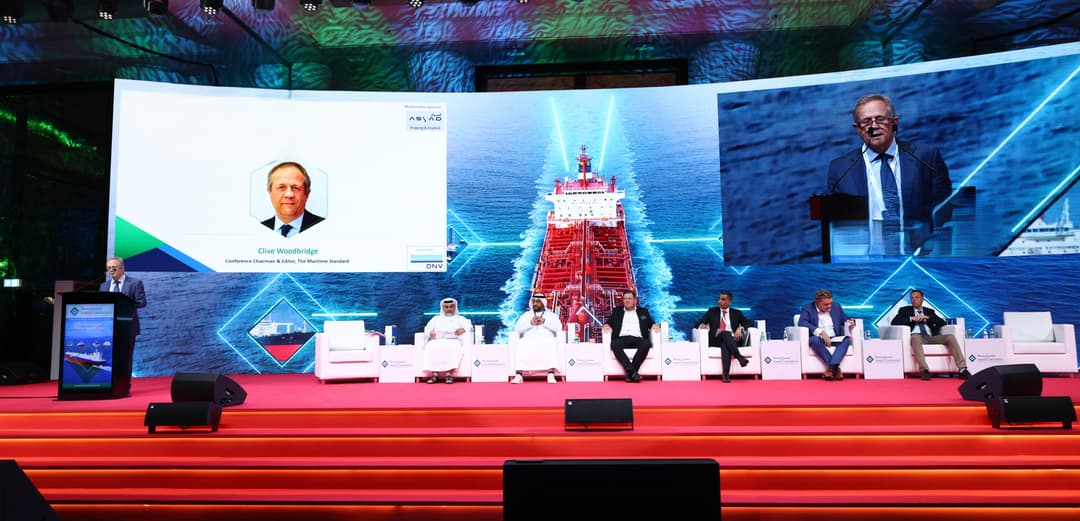
The AITECH Conference
The Maritime Standard AITech Conference 2026
24 November 2026 | Taj Exotica Resort, Dubai, UAE
Blog
February 2026
AI in Maritime 2026: From Autonomous Ships to Smart Ports – The Future of Transport Begins Now
Global transport is entering a decisive decade. The maritime industry, long regarded as conservative and capital intensive, is now at the forefront of one of the most profound technological shifts in modern trade. Artificial Intelligence is no longer a pilot project. It is becoming the central nervous system of ports, fleets, logistics networks, and regulatory compliance systems.
As the industry approaches 2026, the question is no longer whether AI will reshape maritime operations. The real question is this: who will lead, and who will struggle to keep pace?
The TMS AI Tech Conference 2026, scheduled for 24th November 2026, is designed precisely around this turning point. It is where intelligence meets sustainability, where automation evolves into autonomy, and where strategic conversations translate into executable transformation.
This editorial explores why AI in maritime operations is now mission critical and why forward-thinking leaders cannot afford to stay on the sidelines.
The Shift from Automation to Autonomy
For decades, shipping relied on incremental efficiency gains. Larger vessels. Better engines. Optimised routing. But AI introduces something fundamentally different. It brings cognitive capability into maritime systems.
Autonomous vessels are no longer conceptual prototypes. AI-driven navigation systems now integrate satellite feeds, weather analytics, vessel traffic data, and machine learning models to make real-time route adjustments. Smart scheduling systems reduce idle time at ports. AI-powered collision avoidance systems enhance safety beyond human reaction speed.
Autonomy does not simply reduce crew workload. It changes the economics of shipping.
When vessels can adjust routes dynamically based on congestion, weather volatility, and fuel consumption algorithms, margins improve. When predictive models anticipate mechanical issues before failure, downtime shrinks. When cargo handling is optimised using AI-driven yard planning, port throughput increases dramatically.
The competitive edge shifts toward operators who deploy AI not as a feature, but as infrastructure.
At TMS AI Tech Conference 2026, discussions will explore how AI is moving maritime from automation to intelligent autonomy. Industry leaders, technology innovators, regulators, and financiers will converge to discuss scalable implementation strategies and regulatory alignment.
Smart Ports: The Digital Arteries of Global Trade
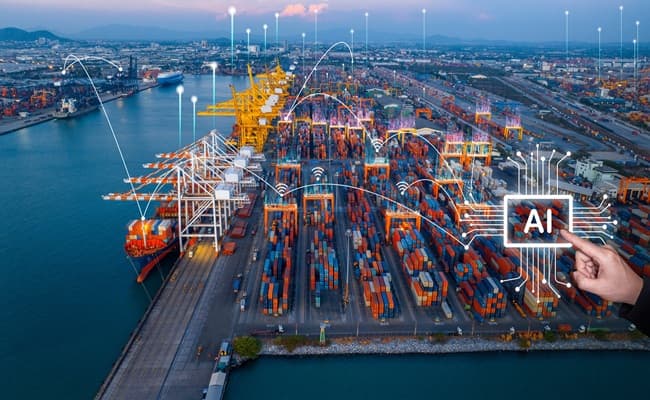
Ports are evolving into digital command centres. In the age of real-time global commerce, inefficiency at ports is no longer tolerable. AI is transforming traditional port operations into integrated, intelligent ecosystems.
Through the convergence of AI, IoT sensors, and blockchain-based documentation systems, smart ports now enable:
- Real-time cargo visibility
- Predictive berth allocation
- Automated customs documentation
- AI-driven yard optimisation
- Intelligent traffic flow management
Instead of reacting to congestion, ports can now predict it. Instead of manual document processing, blockchain-backed smart contracts accelerate clearance cycles. Instead of isolated operational silos, integrated digital platforms create a unified data architecture.
This shift enhances not only speed and efficiency but also transparency and trust across the supply chain.
For investors and shipping executives, the implications are strategic. Ports that embrace AI become regional trade accelerators. Those that delay risk losing competitiveness to digitally advanced counterparts.
The TMS AI Tech Conference will examine how smart ports are redefining trade competitiveness and how stakeholders can collaborate to scale these technologies responsibly.
Real-Time Decision Intelligence in Global Logistics
Modern supply chains operate in an era of disruption. Geopolitical shifts, climate events, port congestion, and fuel price volatility have made static planning obsolete.
AI-powered decision intelligence introduces adaptive logistics. Machine learning models process vast streams of data across air, sea, and land corridors. They simulate alternative scenarios. They recommend dynamic rerouting. They optimise fuel efficiency against time-sensitive cargo priorities.
This is not just operational enhancement. It is resilience architecture.
When disruptions occur, AI-driven systems can:
- Recalculate optimal routes instantly
- Identify alternative ports
- Forecast cargo delays
- Optimise multi-modal transitions
- Reduce emissions while maintaining delivery commitments
In a world where supply chain reliability defines economic stability, AI becomes a strategic asset.
Delegates attending TMS AI Tech Conference 2026 will gain exposure to case studies and implementation frameworks that demonstrate how AI-driven logistics planning can transform risk into competitive advantage.
Sustainability: Intelligence as a Decarbonisation Engine
The International Maritime Organization sustainability targets are not abstract ambitions. They are binding pressures shaping capital flows, chartering decisions, and asset valuations.
AI plays a decisive role in maritime decarbonisation.
Through intelligent route optimisation, vessels can reduce unnecessary fuel burn. Through advanced energy management systems, fleets can monitor consumption patterns in real time. Through predictive emissions analytics, operators can ensure regulatory compliance with measurable precision.
Green shipping corridors are emerging as data-driven initiatives. AI analyses weather patterns, port readiness, fuel availability, and emissions targets to design optimised low-carbon pathways.
Sustainability is no longer a cost centre. It is a data-driven performance strategy.
The TMS AI Tech Conference 2026 will spotlight how AI-powered decarbonisation strategies are enabling operators to meet IMO targets while strengthening profitability and long-term asset value.
Cybersecurity in an Era of Connected Vessels
As vessels and ports become more connected, they also become more exposed.
AI-enabled maritime systems depend on integrated data streams, cloud platforms, and remote operations. Without robust cybersecurity frameworks, digital transformation introduces systemic risk.
Cyberattacks on port infrastructure can disrupt trade flows. Compromised navigation systems pose safety hazards. Data breaches undermine commercial trust.
However, AI also strengthens defense capabilities. Predictive security analytics can detect anomalies in network behaviour. Machine learning models can flag suspicious patterns before breaches escalate. Intelligent threat mapping can identify piracy hotspots and security vulnerabilities in real time.
Cyber resilience must evolve alongside digital adoption.
At TMS AI Tech Conference 2026, cybersecurity experts and maritime technologists will address how to secure intelligent transport ecosystems without slowing innovation.
The Human Dimension of Intelligent Shipping
While autonomy advances, the human dimension remains critical. AI is increasingly being deployed to enhance crew welfare, monitor fatigue levels, and improve onboard working conditions.
Emotional AI-enabled wellbeing and fatigue monitoring systems to detect stress and cognitive overload. Predictive analytics can recommend rest cycles. AI-supported training modules enhance skill development for digitalised operations.
Far from replacing human expertise, AI augments it.
Shipping in 2026 will not simply be smarter. It will be safer and more human aware.
This human-centric dimension of AI transformation will form a key pillar of discussion at the conference, recognising that sustainable innovation must include workforce wellbeing.
Financing the AI Transformation
Technology adoption at scale requires capital alignment. Financial institutions, regulators, and policy makers play a critical role in accelerating AI-driven sustainability.
Green financing models, digital compliance reporting, and performance-linked funding structures are emerging as catalysts for transformation. Investors increasingly favour shipping companies that demonstrate measurable decarbonisation progress and operational transparency.
AI provides the data backbone that makes this possible.
At TMS AI Tech Conference 2026, industry stakeholders will examine how financial frameworks can support AI integration while managing risk exposure.
Why 2026 Is a Defining Moment
The maritime industry stands at a threshold. The convergence of AI, sustainability mandates, supply chain resilience, and digital infrastructure creates both urgency and opportunity.
Waiting is no longer neutral. It is strategic surrender.
Leaders who engage with AI transformation today will define trade competitiveness tomorrow. Executives, technology providers, regulators, and investors must align to ensure innovation is scalable, secure, and sustainable.
The TMS AI Tech Conference 2026 is not simply a technology event. It is a strategic platform for maritime leaders who understand that intelligence is now a core asset class in transport and trade.
On 24th November 2026, the conversation moves from theory to execution.
If your organisation is navigating digital transformation, fleet optimisation, decarbonisation strategy, smart port development, maritime cybersecurity, or AI-enabled logistics, this conference is designed for you.
The future of transport is being engineered in real time.The only question is whether you will be part of shaping it.
Register now and secure your place at the forefront of AI-driven maritime transformation.
Sponsors

Platinum Sponsor

Networking Reception
Multimedia
Delegate Bags
Valet Parking
Platinum Sponsor
Networking Reception
Multimedia
Delegate Bags
Valet Parking
Platinum Sponsor
Networking Reception
Multimedia
Delegate Bags
Valet Parking
Platinum Sponsor
Networking Reception
Multimedia
Delegate Bags
Valet Parking