The AITECH Conference
The Maritime Standard AITech Conference 2026
24 November 2026 | Taj Exotica Resort, Dubai, UAE
Blog
September 2026
Cybersecurity in Smart Shipping: How AI Is Protecting Connected Ships and Maritime Networks
Cybersecurity in Smart Shipping: How AI Is Protecting Connected Ships and Maritime Networks
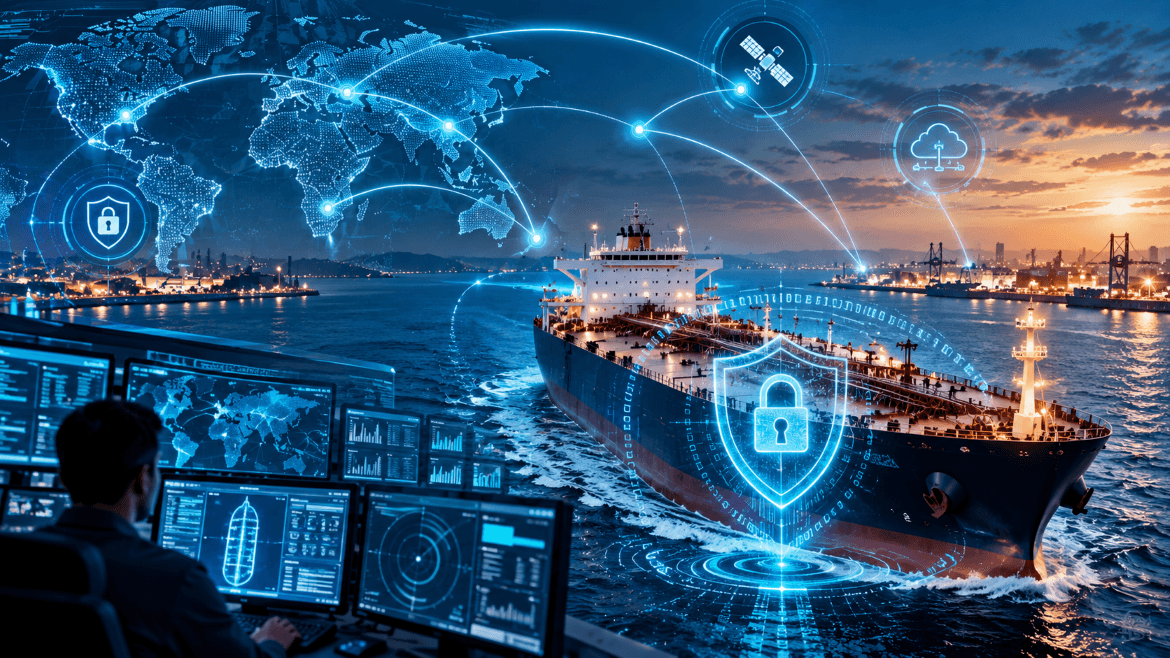
The digital transformation of shipping is creating a more connected maritime industry. Ships increasingly rely on information technology, operational technology, digital communications and connected equipment to support navigation, machinery, cargo operations and communication with shore-based teams.
This connectivity can improve efficiency and access to information, but it also creates new cybersecurity considerations. For the maritime industry, cybersecurity is therefore becoming an operational issue rather than a concern limited to IT departments.
The International Maritime Organization defines maritime cyber risk in terms of the potential for compromised technology assets to result in operational, safety or security failures. Its cyber risk management framework encourages companies to identify, assess and mitigate these risks through established management processes.
Why Connected Shipping Creates New Cyber Risks
Modern vessels operate through an increasingly complex combination of IT and operational technology systems. These can include navigation equipment, machinery controls, cargo management systems, communications and administrative networks.
As these systems become more interconnected, the number of potential points that require protection also increases. BIMCO notes that greater integration of onboard IT and OT systems, together with digital ship-to-shore communications and data links, increases ships' exposure to cybersecurity threats.
The challenge is particularly significant because a cyber incident affecting an operational system can have consequences beyond data loss. Depending on the system involved, disruption could affect vessel operations, safety, cargo handling or communications. This makes cybersecurity part of the wider resilience of maritime operations.
AI Can Strengthen Cyber Threat Detection
Artificial intelligence is creating new possibilities for detecting unusual activity across complex digital environments. Traditional cybersecurity systems can rely heavily on predefined rules and known indicators of compromise.
AI-based systems can analyse large volumes of network and system data to identify patterns that may require investigation. In a maritime environment, this could support the monitoring of connected systems and help security teams identify unusual behaviour more quickly.
AI can also assist with analysing logs, identifying anomalies and prioritising potential threats for human review. The technology does not remove the need for cybersecurity professionals. Instead, it can provide another layer of analytical support in environments where the volume of digital information can make manual monitoring difficult.
Protecting Operational Technology
One of the most important distinctions in maritime cybersecurity is the difference between information technology and operational technology. IT systems generally deal with information and business processes, while OT systems can control or monitor physical equipment and industrial processes.
On a vessel, OT can be associated with systems responsible for machinery and other operational functions. BIMCO highlights the use of IT and OT systems for functions including engine control, cargo management and navigation, making the protection of these systems an important part of maritime cyber risk management.
The consequences of an incident can therefore extend beyond the digital environment. Protecting connected OT requires operators to consider system availability, integrity, access controls, software maintenance and the potential operational consequences of a compromise.
AI Needs Secure Foundations
AI can only provide useful cybersecurity intelligence when the underlying data and systems are reliable. This makes basic cyber hygiene particularly important. Operators need visibility over the systems and devices connected to their networks, appropriate access controls, secure configurations, software management and procedures for responding to incidents.
The industry guidelines on cybersecurity onboard ships recommend measures including hardware and software inventories, secure configurations, audit logs, access controls, awareness and training. AI should therefore complement established cybersecurity practices rather than replace them.
Cybersecurity Across the Ship-to-Shore Connection
The cybersecurity challenge does not end when a vessel leaves port. Modern shipping depends on communication between ships, shore-based operations, service providers and other participants in the maritime supply chain.
These connections can create additional dependencies that need to be considered as part of an organisation's overall cyber risk assessment. This is particularly relevant as shipping companies adopt more cloud-based systems, remote support services and connected equipment.
The IMO's cyber risk management approach is designed to be incorporated into existing risk management processes, reinforcing the idea that cybersecurity should form part of wider safety and operational management.
Digitalisation Is Bringing Cybersecurity Into Regulation
The regulatory environment is also developing alongside maritime digitalisation. In March 2026, the IMO Facilitation Committee approved an overarching Strategy on Maritime Digitalization that emphasises interoperability, standardisation, data sharing and effective data governance.
At the same session, the Committee approved amendments concerning cybersecurity measures for Maritime Single Windows. The proposed amendments are scheduled for consideration for adoption in 2027 and are expected to enter into force in 2029 if adopted as planned.
The IMO has also begun work towards a non-mandatory Maritime Cyber Code. These developments indicate that cybersecurity is increasingly being considered alongside digital transformation rather than as a separate technical issue.
The Emerging Role of AI in Maritime Cyber Defence
AI can contribute to maritime cyber defence in several areas.
Anomaly detection: AI systems can examine network and system activity to identify behaviour that differs from established patterns.
Threat analysis: Large quantities of security information can be analysed to help teams identify relationships between different events.
Continuous monitoring: AI-enabled tools can support the monitoring of connected environments and highlight activity requiring human investigation.
Incident response: Intelligent systems can help security teams prioritise alerts and organise information during a potential cyber incident.
Risk assessment: Historical operational and security data can support the identification of recurring vulnerabilities and areas requiring additional controls. These applications remain dependent on the quality of the data, system architecture and human oversight behind them.
The Human Element Remains Critical
Increasing use of AI does not eliminate the importance of people in maritime cybersecurity. Crew members, shore-based teams, IT specialists, vessel operators and technology suppliers all play roles in maintaining secure systems.
Training and awareness remain important because cyber incidents can involve human actions as well as technical vulnerabilities. BIMCO identifies training as an important risk-mitigation measure and recommends continued attention to cyber awareness across the industry.
The future cybersecurity model is therefore likely to combine automated monitoring with human expertise. AI can help identify patterns and prioritise information, while trained professionals remain responsible for interpreting risks and deciding what action should follow.
Building Cyber Resilience Into Maritime Digitalisation
The maritime industry's digital transformation is unlikely to slow. Connected equipment, digital platforms, remote services and data-driven operations are becoming increasingly important to modern shipping.
The challenge is to ensure that greater connectivity does not create unnecessary vulnerabilities. For shipowners, operators and technology providers, this means cybersecurity needs to be considered during technology selection, system design, implementation, maintenance and operational management.
It also requires coordination between onboard teams and shore-based specialists. AI can become an important part of this approach by helping maritime organisations analyse complex digital environments and identify potential threats.
But effective cyber resilience ultimately depends on a combination of technology, governance, risk management, skilled people and continuous improvement. As shipping moves deeper into the era of connected operations, the ability to protect digital infrastructure will be as important as the ability to use it.
The next stage of maritime digitalisation will therefore not be defined only by how intelligently ships and systems can process information, but also by how securely that intelligence can operate.
Sponsors

Gold Sponsor

Platinum Sponsor

Networking Reception
Multimedia
Delegate Bags
Valet Parking
Gold Sponsor
Platinum Sponsor
Networking Reception
Multimedia
Delegate Bags
Valet Parking
Gold Sponsor
Platinum Sponsor
Networking Reception
Multimedia
Delegate Bags
Valet Parking
Gold Sponsor
Platinum Sponsor
Networking Reception
Multimedia
Delegate Bags
Valet Parking
Supporting Associations







Media Partners