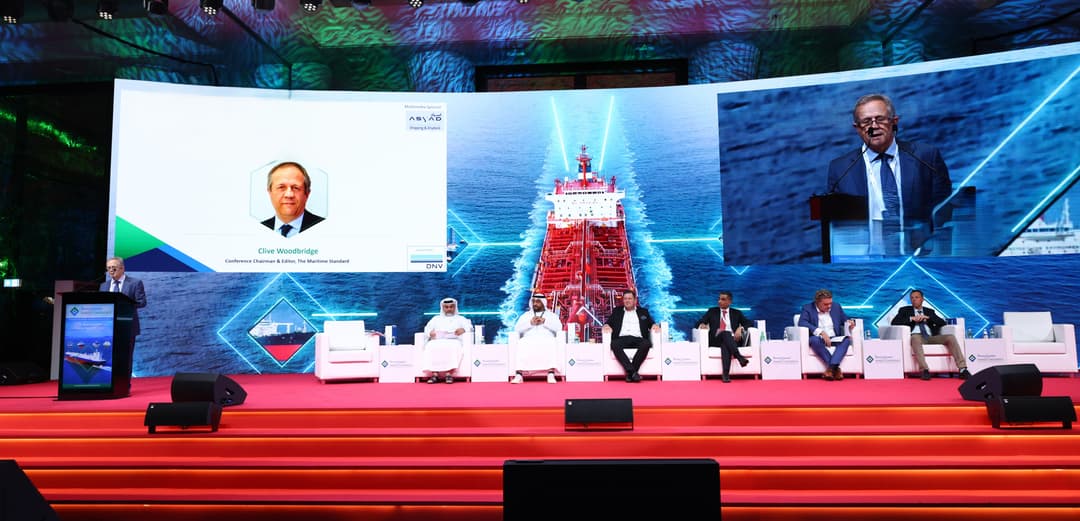
The AITECH Conference
The Maritime Standard AITech Conference 2026
24 November 2026 | Taj Exotica Resort, Dubai, UAE
Blog
October 2026
AI in Marine Insurance: Transforming Risk Assessment, Underwriting and Claims
AI in Marine Insurance: Transforming Risk Assessment, Underwriting and Claims
Marine insurance plays a vital role in international trade, providing financial protection against risks associated with vessels, cargo, liabilities and maritime operations.
Yet assessing these risks can be complex. Insurers and brokers must evaluate information from multiple sources, interpret changing operating conditions and make decisions with potentially significant financial consequences. Artificial intelligence is creating new opportunities to improve how this information is analysed.
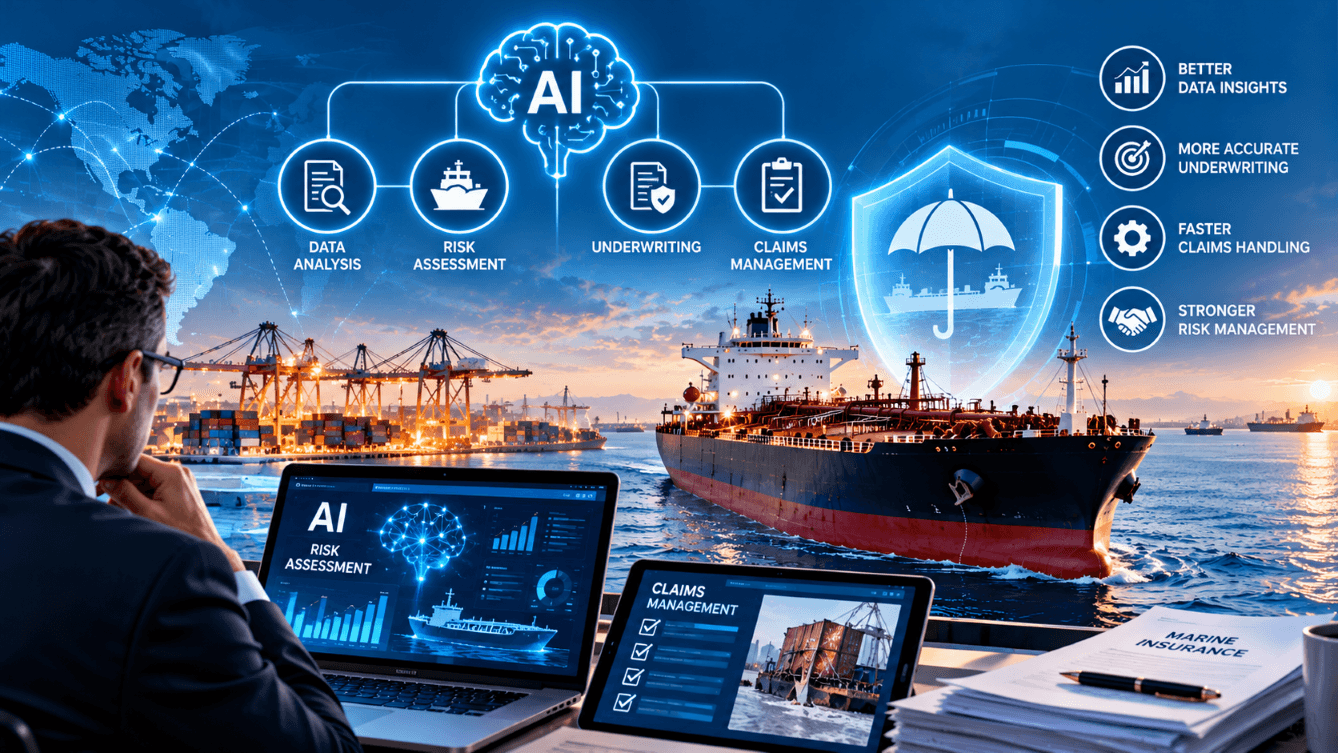
From processing insurance submissions to supporting risk assessment and claims management, AI can help marine insurers handle complex information more efficiently and identify patterns that might otherwise require extensive manual review.
The International Union of Marine Insurance (IUMI) has identified AI as an important area of development for the sector, highlighting potential applications in risk assessment, underwriting and claims handling, alongside challenges involving data quality, governance and implementation.
For an industry built around evaluating uncertainty, the opportunity is significant. The challenge is to use AI to improve the quality of insurance decisions without compromising professional judgement, transparency or accountability.
Why Marine Insurance Needs Better Data Analysis
Marine insurers assess a wide range of risks, including vessel condition, cargo characteristics, operating areas, ownership structures, voyage details and previous loss experience. Each insurance submission can involve substantial documentation and information from different sources.
Traditionally, underwriters have relied on their technical knowledge, historical loss data, inspection reports and other relevant evidence to assess individual risks.
Digitalisation is expanding the amount and variety of information available to support these assessments.
IUMI's Data and Digitalisation Forum identifies connected vessels, ports, containers, packages, satellites and weather stations among the sources contributing to the growing availability of maritime data. AI can help organise and analyse this information, allowing underwriters to identify relevant details, compare information across documents and focus attention on areas requiring further investigation.
However, the availability of more data does not automatically produce a more accurate assessment. Information must be relevant, reliable and sufficiently complete for the decision being made.
AI in Marine Underwriting
Underwriting involves evaluating a risk and determining the terms on which insurance may be offered. The process requires both analytical capability and specialist knowledge of the vessel, cargo, operating environment and applicable policy conditions.
AI can support the process by extracting information from submissions, classifying documents, identifying missing details and summarising relevant risk factors. These capabilities may reduce repetitive administrative work and help underwriters review information more consistently.
Machine learning can also assist with analysing historical data to identify patterns associated with claims frequency or severity.
Such models can inform an assessment, although their reliability depends on the quality and relevance of the data used to develop and validate them. In May 2026, IUMI published a discussion on how AI could transform marine insurance, including its potential to improve risk assessment and underwriting workflows.
The organisation also emphasised that adoption brings challenges that the industry must address. The most useful role for AI is therefore to strengthen the evidence available to underwriters, not to make every underwriting decision automatically.
Improving Risk Assessment
Marine risk assessment often requires information to be considered across several dimensions. A vessel's characteristics may be relevant, but so too are its trading patterns, operating conditions, cargo profile and exposure to particular hazards. AI can help analyse multiple data sources to identify relationships and patterns that warrant further attention.
For example, an insurer could use analytical tools to organise historical claims information by vessel type, cause of loss, location or severity.
The International Union of Marine
Insurance maintains a Major Claims Database designed to improve understanding of significant hull and cargo losses. The database supports analysis of loss frequency, severity, location and cause, helping the industry build a stronger evidence base for risk management.
AI may complement this type of analysis by helping identify patterns in sufficiently detailed datasets. However, historical associations should not automatically be interpreted as proof of causation, and models must account for changes in operating conditions and the limitations of the available data.
Faster and More Consistent Claims Handling
Claims management is another area where AI may offer practical benefits. Marine claims can involve survey reports, photographs, invoices, cargo records, policy documents, correspondence and other supporting evidence.
Reviewing these materials can be time-consuming, particularly when information arrives in different formats or requires comparison across multiple documents. AI-powered document processing can help extract relevant information, organise records and identify missing documentation.
Analytical tools may also help claims teams identify inconsistencies or prioritise cases that require specialist attention. These applications can support more efficient workflows, but they do not establish whether a claim is covered or determine liability by themselves.
Those decisions depend on the policy wording, applicable law, the evidence available and the specific circumstances of the incident. IUMI has identified claims handling as one of the potential areas for AI adoption in marine insurance.
Its discussions also indicate that claims transformation has received less attention than some other digital priorities, despite its relevance to profitability and policyholder confidence. This creates an opportunity for insurers to examine how AI can reduce administrative friction while preserving careful investigation and fair claims assessment.
Fraud Detection and Document Verification
Insurance processes depend on the accuracy and authenticity of submitted information. Inconsistent records, duplicate documentation or suspicious patterns can require additional investigation.
AI tools can assist by comparing records, identifying anomalies and highlighting discrepancies for review. Document analysis may also help claims teams identify information that does not align across different submissions. However, an anomaly is not necessarily evidence of fraud.
Legitimate differences can arise because of reporting errors, changes in circumstances or incomplete records. Any suspected fraud should therefore be investigated using appropriate evidence and established procedures.
The growing availability of AI-generated content also makes verification important. Insurers need reliable methods for checking supporting evidence rather than assuming that a convincing-looking document or image is authentic. AI can help identify issues for closer examination, but human investigation remains essential before conclusions are reached.
The Challenge of Data Quality and Integration
One of the major barriers to effective AI adoption is the fragmentation of information across organisations and systems. Insurers may work with data supplied by shipowners, brokers, surveyors, classification societies, logistics providers and other parties. These sources may use different formats, terminology and data standards.
IUMI's March 2026 discussion of digital transformation in marine insurance identified legacy systems and data quality as important barriers to adoption. It also described an industry approach focused substantially on incremental improvements to existing processes.
For AI applications to work reliably, insurers need to understand where information originates, how it has been validated and whether it is suitable for the intended purpose. Integration also matters. A model operating on incomplete information from one system may produce a misleading result if important context is held elsewhere.
Investment in data governance, consistent documentation and interoperable systems is therefore as important as investment in AI software itself.
Human Expertise and Responsible
AI Marine insurance involves decisions that can affect financial exposure, contractual obligations and the interests of policyholders. These decisions require accountability.
AI models can produce inaccurate outputs, reflect historical biases or fail when applied to circumstances that differ from their training data. A model that performs well in one portfolio may not perform equally well across different vessel types, geographic regions or insurance products.
Insurers need to test their systems, monitor performance and establish clear procedures for human review. They should also be able to explain how AI contributes to an assessment and identify when a recommendation requires further investigation.
The Lloyd's Market Association's AI Adoption Toolkit, published in April 2026, reflects the growing emphasis on governance, accountability and risk management as AI adoption expands across insurance underwriting, pricing, claims and operations.
For marine insurers, responsible adoption means defining the role of AI clearly, maintaining appropriate oversight and ensuring that the technology supports rather than obscures professional responsibility.
What AI Means for the Future of Marine Insurance
AI is unlikely to remove the complexity inherent in marine insurance. Vessels, cargoes, operating environments and contractual arrangements will continue to create risks that require careful interpretation. Its potential lies in helping the industry manage that complexity more effectively.
Better document processing can reduce administrative effort. Improved data analysis can support risk assessment. Intelligent workflow tools can help claims teams organise evidence and prioritise cases. The extent of these benefits will depend on implementation, data quality and the ability of organisations to integrate AI into established processes.
For marine insurers, brokers and shipowners, the priority should be to identify specific problems where AI can deliver measurable improvements, test the results and maintain clear safeguards around decision-making.
As marine insurance becomes more data-driven, competitive advantage may increasingly depend on how effectively organisations combine technology with specialist expertise. AI can help turn information into stronger evidence, but sound underwriting and fair claims outcomes will continue to depend on the quality of the decisions made.
The future of marine insurance will not be defined by automation alone. It will depend on using technology to understand risk more clearly, respond more efficiently and maintain confidence across the maritime industry.
Sponsors

Gold Sponsor

Platinum Sponsor

Networking Reception

Multimedia
Delegate Bags
Valet Parking
Gold Sponsor
Platinum Sponsor
Networking Reception
Multimedia
Delegate Bags
Valet Parking
Gold Sponsor
Platinum Sponsor
Networking Reception
Multimedia
Delegate Bags
Valet Parking
Gold Sponsor
Platinum Sponsor
Networking Reception
Multimedia
Delegate Bags
Valet Parking
Supporting Associations








Media Partners